Friday, 30 December 2011

Delhi, Day 2

Well once again there is a bit of an unintended gap between posts, but Christmas and then another quick trip to Bombay sort of got in the way. But, though a bit late, here is the previously promised post on our second day in Delhi!


Some kids wanted my picture in front of  the tower
Basically our second day was dedicated to the main sites which are actually within the city. So first thing in the morning we packed into our Mahyco cars and headed off to the first of many Delhi icons- Qutub Minar. As soon as we arrived I could tell why this had been assigned so much importance within the city. Amidst arching gates and pillars, a massive tower built of red sandstone simply erupts from the ground. From the very base up to as high as I could see, the tower was wrapped in intricate carvings, particularly inscriptions from the Qur'an. Try as I might it was impossible to imagine such complexity being built close to a century ago, without the modern ease provided by cranes or power tools. How the largest tower in India could have been developed from the ground up out of sheer piles of stone I simply don't know. It makes me realize that while the size of construction may have exploded since 1200, that in no way reflects the imaginative scope it takes to build something like this. No one today would suggest a construction that would span multiple generations, and no where will you find thousands of workers willing to start a project they will never see to the end. The ambition and dedication needed to build structures such as this one will never cease to astound me.

The Lotus Temple from the garden in front.
From there we went to a more modern Delhi sight- the lotus temple. The lotus temple is, as you would guess, built in the shape of a giant lotus flower. It is basically a nondenominational place of worship, though technically it is associated with the Baha'i faith (which thinks that belief and prayer of all kind is holy). I thought it was a really clever building, with pools all around it to simulate a lotus sitting in water. And though it was bustling with school kids and tourists such as ourselves, as soon as you get inside you are met with peaceful silence. I have been in a lot of massive churches, but this one didn't feel anything like those. It was very modern, so the inside was filled with steel arches and supportive beams. I thought it was very interesting, and totally different from most of the places of worship I have visited while traveling.

Next we met Usha for lunch at a place called Karim's, which is a Muslim restaurant. We made our way to the predominantly Muslim part of the city, and pulled up along the main street. From there, the roads were too narrow to continue by car, so we walked out into the winding streets. It is always easy to tell when you have moved into a Muslim area of a city simply by looking around you. For one thing, you will see a lot more people in Muslim clothes, and along the roads all of the shops start selling prayer mats and the traditional skull caps. But another easy way to tell is suddenly instead of just Hindi or sometimes English, all of the signs are written in Urdu, and then sometimes Hindi as well. After wandering through congested streets, we finally made it to the restaurant.

I'm sure the architecture style looks quite familiar.
Karim's is famous for their kebabs, so it was not exactly ideal for vegetarians. But in India there will always be something vegetarian, and they also had fantastic rotis (breads) so I was not complaining. Unlike Hindus, most of whom are vegetarian, Muslims eat a lot of meat, mostly chicken and mutton. So, to continue the Delhi trend, we vegetarians had some paneer, as well as two other vegetable dishes, which were quite delicious. Usha met us at the restaurant towards the end of lunch and we continued to our next sight, which was actually just a few blocks from us. Soon we found ourselves at an arching gate, which would lead us to Humayun's Tomb. Humayun was a Muslim emperor during the Mughal rule. Mughal Emperors ruled for a long time not only in India, but in a good deal of Asia and the middle east. A lot of India's most iconic structures, like the giant dome of the Taj Mahal and other similar buildings, are actually due to this Islamic influence. So Humayun's Tomb also had the characteristics of Mughal buildings- a red sandstone building culminating in a white marble dome. And of course, from top to bottom it is laden with carvings in different coloured stone, both decorative and words from the Qur'an. And one of my favourite details, were the beautifully kept gardens which surrounded the tomb.

Once we had seen some incredibly impressive sights, we decided to finish off the day with a bit of Delhi shopping. A relative of Usha's has a jewelry shop in a nice area of Delhi, so we visited there and wandered a bit in that area, popping into tea and antique shops. Then we were taken to a special scarf and shawl shop, which is particularly known for their pashminas. We spent at least an hour and a half being shown various colours, patterns, and grades of scarf, and then of course once we had selected, we had to begin the tedious haggling process. In most nice Indian shops, you don't actually browse for things. Rather you sit around a cushioned table as the employees of the shop toss item after item in front of you, piling things up until they are eventually swept away and the process starts all over again. We easily saw hundreds of things before we eventually made our choices.

By the time we got back to our hotel we were exhausted from a long day of sight seeing. Rather than attempt to find somewhere nice to eat, we settled for order in pizza and an early night. The next morning we would have to get up early to head for Agra, and I for one was very grateful to settle into my bed. Once again, I think it is probably in all of your best interests that I leave this post here and write up another one for the next day. However this time I will actually be speedy with my further writings! After all, the next day would be the pinnacle of any tourists visit to Delhi, and perhaps India in general. 

Wednesday, 21 December 2011

Arrival in Delhi

Well it has been quite a while since my last post, but believe it or not I am still in India and I swear I haven't forgotten entirely that I should be writing about it. The past two weeks I have actually been away from school, the first of which producing very little write about, and then the past few days suddenly there is a lot to report. Two weeks ago I started to get pretty sick, and low and behold I came down with more or less my first Indian illness. I figured it was only a matter of time, since the Jubilee kids all started getting sick at the same time, when season changed. After all, I am really doing the same thing that they are- trying to build up the immune system to handle a brand new place. So I spent about a week battling off both a bacterial and viral infection, thus producing very little of interest to write about.

Lucky that the sickness happened when it did though, as the next week would bring the trip to Delhi we have been planning for a while. It actually worked out perfectly, with me getting rid of all traces of microscopic invasions just before we left for our trip, which I had been looking forward to since I got here. We left early Monday morning, along with Ben and Brian's cousin Nikita, who hadn't seen the Taj yet and jumped at the opportunity. We reached Delhi in the late morning, and headed straight to our hotel. As always I was excited at the prospect of driving around a new city for a bit, trying to get my bearings and pick out some differences. Right away I noticed that Delhi felt much less dense than Bombay, and the roads, which can be such a huge problem, were actually in fairly good condition. Because Bombay is located on an island, it needed to be tightly packed and built as tall as possible, sort of like New York City. But Delhi doesn't have this constraint, so it is not nearly as vertical as Bombay. There are still a lot of really big modern buildings, but most of those are longer and wider, so you don't exactly feel like you are being surrounded on all sides, as in Bombay.

We reached the hotel, which was right in the heart of a street market. My Mom had flown in early that morning, so I was excited to see her for the first time in months. We all met up, and decided to head out for an early lunch before starting off the day. Usha had business that day, so she was more or less orchestrating our first day from afar; texting us how to get to good restaurants and which sights we should be seeing. She guided us to a great restaurant just around the corner, and we got our first taste of Delhi food of the trip. If there is one thing that Delhi is known for, it is probably paneer. Every meal had at least one, if not two, paneer dishes, and while absolutely delicious, I can pretty confidently say we will be evading the bags of dense cheese  in our own freezer for a few weeks now.

One of the government buildings.
From the restaurant, the six of us drove to our first few sights of the day. There was a noticeable shift the closer we got to India Gate, as streets that were once densely populated by locals transformed into floods of tourists, just like ourselves. The once unfamiliar attention Michael and I get in places like Jalna and Aurangabad has become so ordinary, that at first even I have to adjust to suddenly having foreigners all around me. It actually helps me understand the tendency that locals have to stare, as even I found myself wondering what these travellers were doing in India. What brought them here specifically? Is India just another place on their list of vacation destinations? But people watching, while at times pretty interesting, was not what had brought us here in the first place. As soon as we started walking around, my attention was pulled from my fellow sight-seers, and towards the magnificent structures around us.

India Gate!
India Gate is surrounded by the buildings of Parliament, built in the time of the British. We walked for a while between massive buildings built of a sandy red stone, and at the end of the avenue we reached the President's house. It was gated off, so we couldn't get too close, but the intricacy of the stonework and massive lawn was impressive nonetheless. At the other end of the road we reached our main attraction- India Gate. India Gate is a massive stone archway, built to commemoration Indian soldiers from various wars. When you see video clips of processions in Delhi, they are probably set right in front of the Gate, so it was a fairly familiar site. Of course, as one of the city's most popular tourist destination, there was an immediate onset of touts, pushing their trinkets and souvenirs. I have become pretty familiar with the rush of various touristy must-haves, but I think this was the most aggressive pushing of goods I have ever experienced. One woman who was doing henna actually grabbed my hand and tried to forcibly apply the designs to my skin. I don't really hold it against any of them though, and in the end I still got to see an amazing monument.

The rest of our afternoon was pretty relaxed. We went to a shopping area called Connaught Circus, which was just a series of little shops built into the original British buildings. I always think it is so interesting when the original architecture is preserved and modern things like stores take over the interior. So I enjoyed checking out the buildings as we wandered around for a little bit, before Brian left to pick up his and Ben's cousin Mike from the airport. The rest of us went back to the hotel and decided to check out the surrounding market. I think there is something very unique about the experience of walking around street markets. It is an experience that I have often missed in the United States, because it feels so much more involved than the generic shopping mall. So I had a great time looking at what the stalls had to offer, and of course observing the people around me. There ended up being a couple of things I was interested in, so I also got to experience one of the most iconic parts of a street market- haggling. Of course, being white and speaking minimal Hindi doesn't make it too easy, but I ended up dropping the price from 350 to 250, and it was definitely something new, so I left pretty happy.

We ended the night with dinner back at Connaught Circus, at a place called Kwality Restaurant. While in the United States I would probably take this title to be blatantly sarcastic, and guard myself against glaring fluorescent lights, plastic booths, and intestinal bombardment, in India that is a perfectly respectable name. Indian shops and restaurants are frequented by cutesy spelling and puns, which actually helps them to stand out, rather than forcing them into the American realm of tackiness. Once again we were treated to plenty of delicious Delhi food, and left very satisfied. We opted for an early night, as the next day would of course, be very busy. But I think our second day in Delhi will require its own post, because the current length of this post is threatening to thoroughly overwhelm any reader. Don't fret, I wouldn't dare put you through the intensity of a post four times this size. But believe me, this was just the beginning of our Delhi adventures!

Thursday, 1 December 2011

The Little Things

I think one of the reasons you really have to visit a place to understand it, rather than simply reading about it, is that for the most part research and reading just gives you the big picture. And while getting a general perception of a place is a good thing, what I always miss are the little details that completely endear a place to you. I love noticing the little things about a place that make it special, and that is something you can only get from seeing it for yourself. So I thought I would do a blog post about some of those things- details that might be overlooked in the usual big-picture blog post. So here you go, random thoughts on what I love about India!
  • Ok so it probably doesn't come as much of a surprise that one of the first things I started noticing was the language. And I don't just mean Hindi, I am talking about the difference between American and Indian English. I can't help but notice the way things are structured and phrased, and there is something really fantastic and interesting to me about Indian English. Basically Indian English consists of a lot of direct translations from Hindi that add a bit of a confusing flourish to the language. My favourite example is a teacher at school, who in response to a student chewing his fingernails snapped, "Hey! Don't eat your fingers!" Then there is the accent itself, with its unexpected puffs of air, accentuated consonants, and warped vowels. In short, I never tire of simply listening to daily conversation.
  • Massive metal monstrosities flooding highways, couriering boxes of paperclips or burlap sacks filled with Iowan potatoes, while common-place in America, would seem in India like technology on display in an art museum. For one thing, there aren't really "highways" for them to drive on, but the main point that I am trying to make is that Indian trucks actually bring something interesting to the table. They are all painted bright colours, often with designs criss-crossing from one side to the other, or thin chains draped along the bottom decoratively. Then on the back each of them says something along the lines of "Horn OK Please" in elegantly slanted letters (yet another example of the comedy of Indian English). But my favourite bit of all is the horn. Rather than the constant grating honk of an American semi, the trucks play little bits of Bollywood songs on loop, turning the roads into an animated musical.
So those turned out to be some pretty lengthy descriptions. Now here comes the rapid-fire round.
  • Men walk around holding hands (or just pinkies) because why wouldn't you express how close you are to the people around you? Those stupid stigmas you would find in the west, that frown upon showing affection for they people around you, thankfully don't exist.
  • Facial hair, and lots of it. I'm talking perfectly sculpted curly moustaches galore. Or the carefully trimmed straight across kind that I am starting to think is an official part of the watchmen uniform cross-country.
  • There is a festival to celebrate the cows and buffaloes and how much they do for farmers, in which they paint their horns lots of bright colours. So still these big animals meander through the city with bright red or blue bursting out of their heads.
  • Bright pink turbans. Just walking through villages they are everywhere, and to the average westerner they seem like a huge contradiction (traditional...and bright pink?) but they are perfectly commonplace.
  • Possibly the most characteristic Indian mannerism, which week by week will creep up on you until you become an irreversible convert- the Indian head bobble. Whether it is a sign of ascent or a friendly greeting, I dare you to come to India for more than a month and not find yourself head bobbling every once in a while.
  • My parents will I'm sure remember with chagrin my childhood days when I would let go of all inhibitions and belch completely openly. Well I can now say I was just being multicultural, because the feeling towards burping here is much more relaxed.
  • The majority of people drive motorcycles, not cars, so you frequently see motorbikes with guys holding bizarre things on back. One person is driving and the one in back is carrying a rolled up rug, giant picture frame, roll of cables, or a live goat. You name it, someone has found a way to transport that on the back of a bike.
  • Standard male attire between ages 15 and 30: dress pants, flip flops, and some brightly coloured (often metallic) shirt, generally button down. Yes, it is a pile of contradictions.
  • Every house in town is painted some bright colour like pink or turquoise. So you can tell exactly how old a building is by how far the paint has faded. Towns like Jalna become a sea of pastels with the occasional island of vividly fresh paint.
  • While in the United States a child might get excited about seeing a dog walking in the street, animals of all kind are so commonplace throughout cities that there is no need. Dogs, cats, pigs, goats, cows, and water buffaloes wander around, at times halting traffic, and simply spend their days rifling through street-side garbage. The occasional camel or horse wouldn't even be that uncommon, and in bigger cities I have even seen elephants being led through the streets.
  • If there is ever an accident on the road, somewhere between fifty and a hundred people will just flock to see what is going on. They have absolutely nothing to do with what happened, but they were either hanging out at chai shops, or have pulled their bikes to the side of the road simply out of curiosity. They look at the scene, talk amongst themselves, and create the most intense bottle-necking traffic possible.
  • The smiles. In India, you encounter some of the most genuine smiles on the planet. Simply greeting people you may have never even met before might just make your day.
This is by no means a comprehensive list of the details of life here, but it gives you an idea of a couple of little things that I love about India. I don't think I will ever stop taking pleasure in all these little things, because no matter how long I am here, new things still seem to come up each day. And just as much as the big events from my time here, these are the things that I don't want to let normal life back home make me forget.

    Thursday, 24 November 2011

    South India- Part II

    From Hyderabad we traveled further south to Chennai, one of the biggest cities in south India. We were only there for a day, and for most of that day the Dekhon group was giving a presentation at the local eye-hospital, but I still enjoyed getting to see a bit of a new place. Unlike Mumbai, which is located on an island and thus had to be built upward, Chennai is just an endless sprawl. It's in a much flatter area, right on the coast, so from the heart of the city buildings just explode outwards.

    I spent the morning at the guesthouse where we were staying, along with the cook. Chennai is in Tamil Nadu, so the official language is Tamil, which once again takes precedence over Hindi. The cook however, spoke a good deal of English, and surprisingly some Hindi too, so we were able to get along just fine. She knew that we had come from Maharashtra, so for lunch she made a couple of dishes that I would be familiar with (chapatis, dahl, okra subji) as well as a south Indian dish. It seems that whether or not I will like Indian food is a constant source of concern for people, so it was actually quite sweet of her to make me things which she thought I would be comfortable with. We talked a lot about the differences in food, what I liked about India, and other things like that. Most of our conversation was in English, though often we would each slip in some Hindi words. For a native Tamil speaker, I think it was just as exciting for her to show off a bit of Hindi knowledge as it always is for me.

    The aforementioned giant dosa, called paper dosa.
    I don't think I have talked about the difference in food yet, which is definitely something that needs mentioning. You can find south Indian food just about anywhere, so I was already familiar with some of it. From my first taste it had become a fast favourite, so I had been anxiously awaiting an opportunity to try some of the authentic stuff. The staple of south Indian food is rice, which is much less heavily featured in Maharashtra. Every meal is eaten with some rice variant, so due to the massive demand it is also one of the main agricultural products. A typical south Indian dish, as well as one of my favourites, is called dosa. You find dosa just about everywhere, so when I think about south Indian food, this is the first place my mind goes. They are like crispy rice pancakes, and are often eaten with a sort of soup called sambar. There are lots of different varieties of dosa, some of which have vegetables folded into them, and others are a couple of feet long, all curled up and crispy.

    The actual style of eating is different as well. In Maharashtra, everyone eats with their hands, which I practice I was more than happy to adopt. Some people say that utensils taint the flavours of the food, and while I'm not so sure that is true for me, any chicken nugget and french fry loving kid will agree, that there is simply something fun about eating with your fingers. Anyway, in Maharashtra it is perfectly polite to mash up your food on your plate and suck it off the tips of fingers, formed into a pinched triangular cup. The only rule is that the food can never pass your top knuckle, everything must be kept on your fingers. If you don't keep your eating habits under control, you risk appearing rude or provincial. In the south however, all rules of etiquette are thrown to the wind. On the average south Indian plate you find a monstrous pile of rice, a couple of vegetable dishes (generally soupier than those found in Maharasthra), and often some dahl. But those dishes don't stay segregated for long. With the whole hand (I'm talking all the way up to the wrist) everything is mixed together into one giant slop. Then, again using the entire hand, the mush is rolled into balls and gobbled up from an open palm. By the end of the meal, the shiny metal surface of the plate is the only thing even remotely clean.

    Once everyone had finished their meetings, we went out to dinner. To get to the restaurant we took one of the most readily available sources of transportation, and one of the most fun for me- the rickshaw. These aren't the kind of rickshaws that are pulled by bicyclists, they are auto-rickshaws and you find them everywhere in India. They run on natural gas, so they can only go so fast, but they are a really convenient way to get around. They are open on the sides so you are completely vulnerable to the elements, which could be either a blessing or a curse for some. Personally, I like being able to move through a place without feeling sealed off from the sights and sounds, the way you are in a car. In fact, the rickshaws are so prevalent, that schools use them as buses. It would be impossible to send a big bus all over the city to get children for school, and a big bus is expensive. So every morning in Jalna you see rickshaws, which can almost comfortably sit three in the back, carrying somewhere around ten kids. They pile in, sitting on top of each other, in the driver's lap, or standing up with their heads sticking out the sides. It's not exactly the strict safety standards of the American school system, but it makes school accessible for kids who might otherwise be out of reach.

    Sorry to go on a bit of a tangent here, but I think the schools using rickshaws is a good example of the way problems are approached in India. If a problem like schools not being able to afford buses arose in the United States, everyone would go through an incredibly complicated and lengthy process to fix it. A public system would be set up and meticulously planned so that, months after the problem arose, it would be fixed, once and for all. In India however, you basically go straight through problems, sometimes in outlandish and complicated ways, but often just simple right-off-the-bat solutions. You do whatever is necessary to make the problem go away, with as little extra-energy expended as possible. It's like a truck that I saw driving around Jalna, with a huge load towering above the truck bed. With a load that tall, an American driver would have meticulously planned his route, no matter how long it ended up being, to avoid any obstacles. But here, I watched as the driver paused at an electrical line that spanned the road. Two men hopped off and pulled out giant wooden poles, which they used to hold the wire up as the driver continued under it. There is no point dwelling on a problem, it just takes a little creativity and you can get on with life.

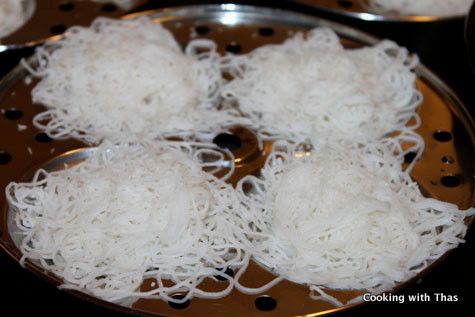
    Anyway, when we got to the restaurant we had a south Indian feast. We got three curries, two of which were sea food based since Chennai is right on the coast, to go with the inevitable rice-based dish. First, we had probably the most ridiculous looking thing I've eaten on this trip so far. I wish I had had my camera with me, but I have included a picture I found online just to give you an idea. Basically, it looked  like a little spaghetti monster, but it was made out of rice of course. It is called idiyappam, and is made from a rice batter that is squeezed out into long threads and piled up. You tear off chunks to dip into the curries, and I must say, it was delicious. Next we had appam, which is similar to dosa, in that it is rice batter that is pan fried. But unlike dosa, it has a big doughy puff in the middle. This was actually the first south Indian food I ever tried, so it was sort of like returning to my first food love.

    Unfortunately, we didn't have time to see much of the city. One thing Chennai is really known for is its churches, because like a lot of the south, there is some heavy missionary influence. So it's too bad that we didn't get to see any of those, since some of them are apparently really impressive. But who knows, maybe I will get to come back one day. If that is ever the case, I think I now at least have a better culture understanding of southern India, so those grande sights could have a bit more of a backdrop.

    Monday, 21 November 2011

    A Stint in South India- Part I

    As mentioned in my last post, after our bit in Bombay we headed to South India, for a few days in Hyderabad and Chennai. It was my first time in the south, and I was excited to see a new and unique part of the country. India is a huge place, which was only recently united into one national unit, so basically anywhere you go you will find major differences. Each city we visited had its own language, unique scenery, and traditional way of doing things. It made me realize how difficult it is to say that you have become familiar with "Indian" culture as a whole. So far, I been immersed in Maharashtrian culture, but that is barely grazing the surface of this wonderfully eclectic country.

    The first city that we visited was Hyderabad, in the state of Andhra Pradesh. The official language is Telugu, so though it is the official language of India almost no one speaks Hindi. It also has a high Muslim population, so there are also a lot of Urdu speakers. Because of these language divides, English often becomes the lingua franca, as schools will teach the local language plus English. Though the language spoken is different, there is actually a long historical connection between Hyderabad and Mahrashtra, particularly the Jalna District. They were once a larger state, and at one point a Mughal emperor even moved the capital to Aurangabad. The connection continued through the Nizam period (1724-1948), when Hyderabad State was ruled by the Asaf Jahi dynasty. In fact, due to the Nizam's resistance, Jalna District was one of the last places to become a part of the nation of India, a full year after independence. Due to this close historical connection, there are actually a lot of shared traits between Jalna and Hyderabad. These range from small linguistic things like saying "Hao" for yes instead of the Hindi "Ha," to more prominent traits such as the general propensity towards being late.

    Despite some similarities, right away I noticed a lot of major differences. For instance, the infrastructure in Hyderabad is far more developed than that of Maharashtra. I first noticed this in the roads, which all seemed relatively freshly paved, with multiple lanes. One of the major problems that cities like Aurangabad and Jalna face is the horrible state of their roads. Very little of the public money goes into road maintenance, so simply getting to school every morning becomes a struggle against an army of potholes. Then, as we were driving through the city, I noticed hospitals, pharmacies, and medical specialist centres everywhere. While not completely absent, these necessities are much less prevalent in places like Jalna, though admittedly it is a considerably smaller town. I asked Barkha (Ben and Brian's cousin) about why the infrastructure was so much more developed. Apparently this is commonplace throughout the south, where the political climate is much calmer than in Maharasthra. Corruption, a major problem in Indian government, while not entirely absent, is less oppressive than in Maharasthra. And fewer extreme religious groups make it easier for the government to make changes and get things done.

    Char Minar, as seen from the bangle market.
    Once the business part of the trip in Hyderabad was over, we went out to see a bit of the city. First we went to Char Minar, one of the most famous sites in Hyderabad. It is a mosque with four minarets, built to commemorate the end of a plague in the city. We went up to the first level of the towers, to look out over the bustling market area around the monument. Char Minar is located in a heavily Muslim populated area, so almost all of the signs were in Urdu, and most of the people in the streets were wearing traditional Muslim clothing. After our trip up the monument, we wandered through the bangle market just next to it. As we walked through the streets, men from the shops would shout to us to come look at things, and peddlers of other small trinkets crowded us from all sides. We eventually ended up in one of the shops, to get a better idea of the types of bangles that Hyderabad is evidently known for. The shop was lined wall to wall with bangles, necklaces, and earrings. The ceilings were covered in mirrors and dozens of light bulbs hung from wires to make all of the jewelry shine. I didn't buy anything, but we did use it as an opportunity to try our hand at bargaining. Needless to say, the two white people curiously looking on were not helping Barkha earn us the lowest price.

    One of the bangle shops
    After the market we visited Birla Temple, so that we could get a look at a Hindu temple as well. This one was much more modern, but still it was great to take a look at yet another display of religious grandeur. The entire building was made of white marble, though unfortunately cameras weren't allowed so I can't provide any proof. As we walked up the steps into the temple we passed statues and carvings set into the walls, depicting various gods and goddesses. The walk into the temple was designed to mirror a pilgrimage, so we were sent along a path all the way around the temple before we could enter.

    We only spent two days in Hyderabad, but nonetheless it was a dense trip. From there we continued onto Chennai, and the topic of my next blog post.

    Monday, 14 November 2011

    Bombay Trekking

    For a while now, we have been wanting to go to Bombay for a trek, just outside the city. There are some excellent hiking opportunities about an hour from Bombay, and personally I have been itching to get back into the great outdoors, particularly if it means discovering the scenery of a new country. So when Ben, Brian, and Michael needed to take a trip south to meet with some people and take a look at some eye hospitals, we thought it would be perfect to first spend a bit of time in Bombay. The plan was to travel to Bombay for two days, then continue on to Hyderabad (where we are now), and then finish up the trip in Chennai.

    The original plan was to take the train from Aurangabad to Bombay, which takes about eight hours, but would give you a great look at Maharashtra. Unfortunately, our tickets didn't quite go through. We booked our tickets in advance, but we were put on the wait list. Basically that means if some VIP decides last minute that they want to take the train, we can get bumped. And that is precisely what happened, unfortunately. Particularly in India, connections can get you a long way. But luckily we found out about the tickets the night beforehand, and we weren't about to dwell on it. So we quickly booked plane tickets, which in the end earned us a few more hours of sleep than the 4 AM train would have.

    We arrived in Bombay around 10, and since we were all a little exhausted we decided to hang out at the Bombay house for a while before heading out. So like the super cool people that we are, we flopped and watched multiple hours of How I Met Your Mother. But hey, every once in a while you have to indulge your American tv cravings. Once it got to be about lunch time, we headed out to my favourite restaurant in Bombay, and one of the things I was most excited about for this trip- Swati Snacks. Basically it serves typical street food, in an environment that won't tear my poor western stomach to bits. There is a huge selection, and it is great for sharing and getting a little taste of lots of different types of Indian food. Needless to say, I left lunch very satisfied.

    After lunch we went to Phoenix, the biggest mall in Bombay. Stepping into that place, I felt like I was back in the west. Suddenly all of the stores were filled with European designer clothes, that were easily as expensive, if not more, than the things you would find in the US. And walking around, I found that the salwar kameez or sari that I have gotten used to seeing, had been replaced by short shorts and tank tops. I hardly saw any Indian clothes at all, just a few shops that were tucked away on the top floors, and the occasional older shopper. And for once, the white girl who was walking around didn't attract nearly as much attention. The posh Bombay kids weren't about to crane their necks at a display of western culture, when they pull on a pair of jeans and a printed tshirt just as often as do.

    After some window shopping, we went to see a movie at the mall's theatre. At first glance, the theatre once again felt like a pool of western influence. But upon closer inspection I soon found that it was filled with some key cultural differences. For one thing, in addition to popcorn, one of the standard movie snacks is steamed corn with spices. It has the potential to be a healthy alternative to the greasy American classic, but considering the amount of butter they mix in, it really isn't all that much better for you. Then when we got into the the theatre, we had to find the seats that had been assigned to us on our tickets. And soon after sitting down, we had to stand back up again as they played the national anthem. I have gotten so used to hearing the kids sing it every morning, that I was almost expecting a chorus of "Goodmorning Teachers" as soon as the song ended, just as the students do. Then the movie started, and after an hour of standard movie watching, there was an intermission. All Indian movie theatres have intermissions, where people come around with snack menus. In Bollywood movies they have the intermission built in, so it works out just fine. But when they are showing western films, they have to stop it at a random point. The movie practically stopped midsentence, and then was backed up a bit when it started up again.
    After the movie we went to dinner with Ben's cousins Deepak and Shirish, their wives Sarika and Pragaya, and two more cousins, Payal and Pooja. A good deal of the family lives in Bombay, so it has become a sort of hub for visits. As I have mentioned, visiting family is a very important part of Indian culture. You don't simply see people once a year for Christmas or Thanksgiving like in the US. So whenever we are flying through Bombay, it is important that we try and see everyone we can, at least once. And with such a large international family like Ben's, it is actually quite convenient. Whether they are visiting London, Toronto, or Chicago, there is always an available place to stay.
    The next morning was the day if our hike. We left the house at six, so that we could be done hiking before the crippling heat of the afternoon fully set in. The six of us (Ben, Brian, Michael, two of Ben's friends from the colony, and myself) were joined by Deepak and a few of his friends. We all piled into three cars, and first headed over to a restaurant that was open early enough for some breakfast. The place was packed with people that were heading off to work. It basically reminded me of the Indian version of a 24 hour diner. And it was definitely far from your average tourist destination, so Michael and I were getting some particularly curious looks. We had idli sambar, which is a rice-based southern dish, and I had probably the best cup of coffee I have had all trip. It was served in a small metal cup, which you are meant to pour into a larger metal dish. All of the sugar is at the bottom, so you can pour it back and forth between the two dishes to mix the sugar in, depending on how sweet you want it. The wider metal dish also helps to cool the coffee to a better drinking tempature.
    One of our first big views of the scenery from the trail.

    Once we had eaten, we headed off towards Karnala Bird Sanctuary, where we would be hiking. It is amazing how quickly things transition from a densely-packed urban environment to sprawling mountains and hills. On our way out of the city, there was a brief break in buildings and then we passed through New Mumbai. New Mumbai is basically the equivalent of the suburbs, though it looks nothing like the American version. It is considerably less dense than downtown Mumbai, but still it is made up of tall apartment buildings. We continued for about half an hour from there, and then finally reached our hiking site.
    Our rugged Indian trail required some expert butt-scooching.

    Suddenly finding myself in a calm natural retreat, it seemed impossible that we could be such a short drive from a bustling metropolitan area. It felt fantastic setting off on a trail for the first time in so long. Of course, there were huge differences between our rugged Indian trail, almost more of a staircase of roots and rocks, and your average well-maintained American trail. But no matter where you may be, there is always familiar comfort in being outside, treating your body to some pleasant exhaustion. And I actually loved the fact that the trail was so different from what I was used to. At no point was I going to get into a groove and let my mind believe I was back in the Rocky Mountains. The whole way I was aware of the fact that I wasn't just exploring a new mountain, but the outdoors of a new country.
    View from close to the top of the mountain.

    We were hiking to the top of a mountain, where we found ourselves at an ancient fort called Karnala killa. The mountain is sometimes referred to as the thumbs up, because from the fort a giant point shoots up, making the entire mountain look like a hand. Of course, more than anything it made me want to rock climb to the actual top, because something about getting almost there just tore me up, but that would have required ropes and harnesses. Along the way we saw lots of wildlife, like giant spiders (I exaggerate not, they were probably about the size of my hand), monkeys, and the birds which were under protection. And once we got up high enough, we started seeing the magnificent mountain range that we found ourselves in. I think there is something really unique about Indian mountain ranges. The mountains were covered in trees and just rolled on as far as you could see. In the valleys between mountains and even over their tops, winter had brought a layer of thick mist. It was like gazing at a massive expanse of bubble wrap covered jungle, each mountain waiting for someone to reach over and pop it.
    The walls of Karnala fort.

    That was the main event of the trip, after which we mostly relaxed until our early morning flight to Hyderabad the next day. When I get home, I will write a post about our time in the south. So far though, I can very easily say that I have been having a great time with our bit of Indian travel. After all, that is why I am here- to experience and learn as much about this fantastic new country as I possibly can.

    Friday, 4 November 2011

    Mahyco

    I realized recently that I have mentioned a few times that I am staying on "a compound," but I never quite elaborated on what that is. For those of you who know specifically where I am staying, you can think, "Oh she is just talking about Mahyco again." But if you don't know what that is, it probably sounds like I am right in the middle of a bad sci-fi movie or something. But fear not, my India experience is not rooted in becoming some strange experiment, and I swear I haven't been made into an alien avatar yet. So, to avoid further confusion, here is my little explanation of where exactly I am staying.

    I am staying on a research facility which is owned by Mahyco, or Maharashtra Hybrid Seed Company. It is part of the Barwale foundation, which was founded by Ben's grandfather. The compound, as I call it, is made up of a colony where scientists and their families can live, the labs, greenhouses, the office building, a new facility where guests can stay, and our house. Mahyco is a company that works to create hybrid and genetically modified crops to be sold throughout India. They have a number of hybrid crops on the market already, and one BT (basically you use a bacterium to alter the genetic makeup) crop, which is cotton. 

    Now that you have a basic idea what Mahyco does, I feel like I should touch on the actual topic of genetically modified foods. GM gets a really bad name in the United States, mostly because Monsanto is pretty much the only big name that people know of, and they give the whole business a bad name. Then you have companies like Greenpeace which also try and paint it as something evil, to be avoided at all costs. Keep in mind, this is all coming from a person who loves supporting local farmer's at farmers markets and frequents the food co-op regularly. I do take the environment very seriously, but the fact is, it simply doesn't make sense to expect that organic farming practices are at all realistic here.

    In a country with as big a population and as low an average income as India, the most important thing becomes using land to its fullest potential to make sure that everyone can eat. So the way I see it, you have three options in farming practices. There are pesticides, organic farming, and genetically modified foods. Pesticides are probably the only common ground between environmentalists and the food scientists that you would find here. While they do increase yield, it is at the cost of environmental health and safety, placing it far away from the ideal situation. Then you have organic farming. Basically this involves a lot more work on the part of the farmer, and considerably lower yields. Lower yields, if widely adopted, would lead to higher food prices, which would lead to a large percentage of people not eating. Then you have genetically modified foods. GM requires considerably less pesticide, yet the plants are far more insect and virus resistant and produce a much higher yield. All in all, you are producing the food required to sustain a growing population, without compromising the environment's health.

    Basically, I agree with a lot of organic farming principles, but organizations that completely exclude GM as a possibility are being stubborn. I agree that our focus should be health and stability of farm land, but GM in no way compromises that. I understand the desire to try and leave crops as basic and natural as possible, because environmental conservation is extremely important to me. But when you look at food production on a larger scale, it is made of a series of hybridizations that have been going on for thousands of years. Food production as a process is rooted in humans taking wild plants and domesticating them to suit their needs. It is not realistic to think that we can go on growing plants the way that they occur in nature on a large scale. Think about the rubber-band theory for example, in which a rapid development of one area of society necessitates the development of all others. With modern medicine increasing the average life expectancy, we have more or less passed our planet's carrying capacity. If we are going to use technology to increase the size of our population, it only makes sense that technology is required to sustain it. And that is why what Mahyco is doing is so important. You do see people starving here, but Mahyco tries to change that without compromising the integrity of this beautiful country itself.